
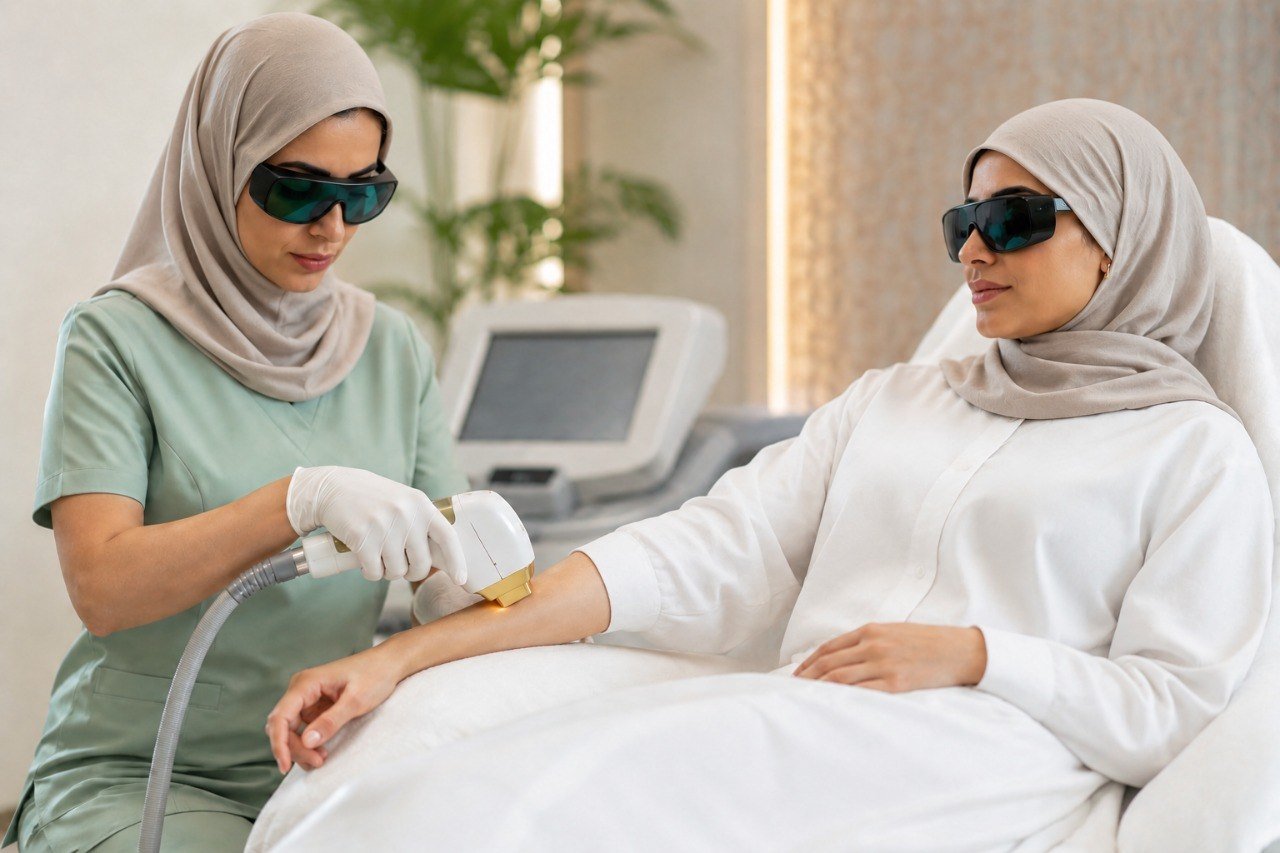
The question how many laser sessions does the body need? is one of the most common questions women ask before starting laser hair removal sessions.
However, there is no fixed number that suits all women or all body areas, because the response varies depending on hair color and thickness, skin tone, the treated area, hormonal factors, and how consistently appointments are attended.
Laser hair removal services for women are available at the four Rawnaq Medical Complex branches in the Eastern Province:
- Al Olaya Branch – Khobar.
- Ishbiliya Branch – Khobar.
- Seihat Branch.
- Abqaiq Branch.
The available services include sessions for individual areas, full body, and multiple packages, with options that include touch-ups according to the service and the policy adopted at each branch.
Read Also
Laser Hair Removal for Women in the Eastern Province: Your Guide Before the First Session.
The Direct Answer
Laser hair removal usually requires several sessions, not just one. Many people may need around 4 to 8 core sessions, but the number may increase or decrease depending on the area, hair, skin, hormonal factors, and individual response.
Mayo Clinic notes that many people need around 4 to 8 sessions, while the American Academy of Dermatology indicates that a large number of patients may need 2 to 6 sessions. This difference in ranges reflects an important fact: a final number that suits everyone cannot be determined before monitoring the case's response.
What Affects the Number of Sessions?
| Factor | Expected Effect |
|---|---|
| Dark, thick hair | Its response is usually clearer |
| Light or fine hair | Its response may be slower or limited |
| Face and chin | May need longer follow-up due to hormonal effects |
| Hair density | May increase the time needed for a clear reduction to appear |
| Consistency with appointments | Helps complete the plan in an organized way |
| Removing hair from the root | May affect the effectiveness of the sessions |
| Hormonal factors | May lead to continued appearance of new hair |
| Sun exposure or tanning | May require adjusting the appointment or settings |
- One session is usually not enough.
- The number varies from one woman to another and from one area to another.
- Not all hairs in an area respond in the same session.
- Facial hair may need longer follow-up than some other body areas.
- Hormonal factors may lead to the appearance of new hair.
- The interval between sessions is determined by the specialist based on the area and response.
- Touch-ups are not a substitute for the core session.
- Some cases may need follow-up sessions after the core program ends.
Why Does Laser Need Several Sessions?
Laser targets the pigment inside the hair and affects the follicle when the hair is in an appropriate phase of the growth cycle.
But the hair present in a single area is not all in the active growth phase at the same time. Some hairs are in a growth phase, while other hairs are in a resting or transitional phase.
Therefore, the session affects a proportion of the hair, then the following sessions target other hairs as they enter the appropriate growth phase. For this reason:
- Not all hair disappears after the first session.
- Repeating sessions within a few days is not necessarily more effective.
- Some hair returning does not mean the previous session failed.
- The result needs consistency and follow-up over several sessions.
Specialized medical bodies explain that most cases need a series of sessions, and that the number of sessions or how long results last cannot be precisely determined in advance for everyone.
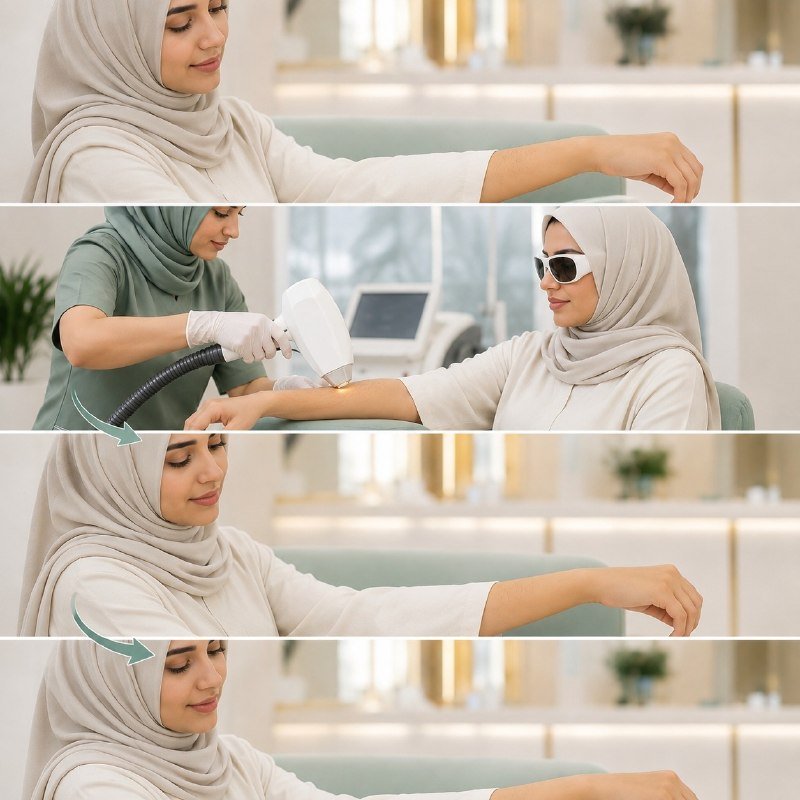
Growth Phase
Most ResponsiveThe hair is active and contains more pigment, so laser targets it effectively.
Transition Phase
Lower ResponseThe follicle begins to shrink, so its targeting effectiveness in the session decreases.
Resting Phase
Treated LaterThe hair is inactive, and it is targeted in later sessions once it enters growth.
Does the Number of Laser Sessions Differ by Area?
Yes, the response varies by area, because the hair growth cycle, density, thickness, and hormonal sensitivity are not the same across all parts of the body.
| Area | General Note |
|---|---|
| Face and chin | May be affected by hormonal factors and need longer follow-up |
| Upper lip | Small area, but the hair may be fine or affected by hormones |
| Underarms | Dark, thick hair response may be clearer |
| Bikini | Response varies depending on hair density and thickness |
| Legs | A clear, gradual reduction may appear with consistency |
| Arms | The number is affected by the nature and thickness of the hair |
| Abdomen and back | Response may vary significantly between cases |
| Full body | Each area is evaluated independently |
Booking full body does not mean all areas will finish in the same number of sessions; one area may respond quickly, while another may need additional sessions or longer follow-up.
What Factors Determine the Actual Number of Sessions?
Hair Color
Laser targets the pigment inside the hair. Therefore, dark hair usually responds more clearly than white, gray, or very light blonde hair, which contains less pigment.
Hair Thickness
Thick, dark hair may respond more clearly than very fine hair. As sessions progress, the remaining hair may become finer and lighter, which is why the response may seem slower in the later stages compared to the first sessions.
Skin Tone
Laser can be performed on different skin tones, but the appropriate technology and settings must be chosen while considering the skin tone and recent sun exposure. Increasing the device's energy does not automatically mean a better result; the appropriate setting is the one that balances the desired effect with skin safety.
Hair Density
The denser the area, the longer it may take for a clear reduction in the number of hairs to appear. The result is not measured only by hair disappearing, but also through:
- Reduced density.
- Slower growth.
- Longer time between shaves.
- Reduced hair thickness.
- Areas appearing less dense than before.
Hormonal Factors
Hormonal imbalance may lead to the continued appearance of new hair, especially on the face, chin, neck, and some body areas. Laser helps reduce existing hair, but it does not treat the hormonal cause itself. Some cases may need more sessions or spaced-out follow-up sessions.
The American Academy of Dermatology indicates that facial results in women may be affected by hormones, and that hair can grow back and be re-treated when needed.
Consistency With Appointments
Being consistent with appointments helps target hair as it appears in new growth phases. Repeated delays, on the other hand, may lengthen the program's overall duration. Conversely, scheduling sessions too early does not mean reaching the result faster.
Following the Instructions
The basic instructions include:
- Not using sugaring, waxing, or tweezing between sessions.
- Shaving according to the branch's instructions.
- Avoiding tanning and intense sun exposure.
- Disclosing medications.
- Informing the team of any inflammation or wounds.
- Not using irritating products without guidance.
To learn the preparation and aftercare instructions in detail, you can refer to the first article instead of repeating them here: Laser Hair Removal Guide Before Your First Session.
How Many Sessions Does Full-Body Laser Need?
Full-body laser needs a series of sessions just like individual areas, but there is no single answer for all body parts. Several areas may be treated in the same appointment, yet each area has a different response pattern. For example:
- The underarms may respond faster than the face.
- The bikini area may differ from the legs.
- The abdomen and back may be affected by the nature of the hair or hormones.
- Some facial areas may need longer follow-up.
Therefore, each area within a full-body program must be evaluated independently, and the number of sessions for one area should not be considered a final indicator for the rest of the body. Rawnaq Medical Complex offers full-body options with or without the back and abdomen, in addition to options that include touch-ups according to the approved service.
What Is the Interval Between Laser Sessions?
The interval between sessions is usually several weeks, until a new group of hair appears in a phase suitable for treatment. But there is no single interval that applies to:
- All body areas.
- All women.
- All stages of the program.
- All hair types.
The team may set a different interval for the face than for the legs or body, and the time between sessions may also change as hair appears more slowly in advanced stages. Medical bodies recommend asking the specialist about the number of sessions, the expected interval, and the required instructions before starting.
What Happens if You're Late for a Session?
A delay does not necessarily lead to losing the result of previous sessions, but it may:
- Lengthen the program's overall duration.
- Allow a larger amount of hair to appear between sessions.
- Make monitoring the response less consistent.
- Delay reaching the targeted reduction.
If you can't make it, it's best to contact the branch to reschedule instead of leaving the program without follow-up for a long time.
Can the Interval Be Shortened to Speed Up Results?
Not necessarily. Performing the session before a suitable proportion of hair appears in the growth phase may not add the expected benefit, despite exposing the skin to another session. The session's timing should be determined based on the nature of the area and the response, not the desire to finish sessions quickly.
When Do Laser Results Start to Appear?
Not all hair falls out immediately after the session ends. Treated hair may take several days or weeks to gradually come out of the skin. With repeated sessions, you may notice:
- Slower hair growth.
- Reduced density.
- Bare patches appearing.
- Longer time between shaves.
- Finer, lighter hair growing.
- A reduced amount of hair appearing after each session.
Results may last for months or years for some people, and when hair grows back it is usually less, finer, and lighter in color, but follow-up sessions may still be needed.
How Do I Know Laser Sessions Are Working?
The result can be tracked through a set of indicators, not just by waiting for hair to disappear completely:
- Shaving is now needed at longer intervals.
- Hair density has decreased.
- Hair has become finer.
- Areas with less hair have appeared.
- Hair growth has become slower.
- The amount of hair returning between sessions has decreased.
It's best to compare the area at intervals and in a consistent way, rather than judging the result after a single session.
Why Might the Result Be Slower Than Expected?
The response may slow down due to:
- Light or fine hair.
- The presence of hormonal factors.
- Inconsistency with sessions.
- Using methods that remove hair from the root.
- Sun exposure or tanning.
- Differences in the area's growth cycle.
- Delaying appointments for long periods.
- Not disclosing medications.
- Comparing your case to someone else's result.
- Expecting hair to disappear after a few sessions.
A slow response does not mean the solution is to automatically raise the device's energy; the area, settings, medical history, and previous response should be reviewed instead.
When Should the Plan Be Reviewed?
The plan should be discussed with the specialist when there is:
- No change noticed after several regular sessions.
- A sudden increase in facial or body hair.
- Coarse hair appearing in new areas.
- A large difference in response between areas.
- Severe, recurring irritation.
- Burns, blisters, or a persistent change in skin color.
- Starting a new medication.
- A health or hormonal change.
- Pregnancy or possible pregnancy.
What Is the Difference Between the Core Session, Touch-Ups, and Follow-Up?
| Type | Purpose |
|---|---|
| Core session | Treating the booked area within the core program |
| Touch-up session | Treating limited hairs or areas as needed and per the package policy |
| Follow-up session | A spaced-out session after the program ends when new hair appears |
The Core Session
This is the session scheduled within the hair removal program, during which the service is performed on the booked area.
Touch-Ups
This is a limited session to deal with remaining hairs or areas according to the service's terms and the facility's policy. A touch-up does not mean:
- Repeating the entire session.
- Guaranteeing all hairs will disappear.
- A substitute for the next core session.
- A fixed service included with every package.
Follow-Up Sessions
Some women may need spaced-out sessions after the core program ends when new hair appears. This varies depending on the area, hormonal factors, the nature of the hair, and how long the result lasts. ASDS explains that some people need additional sessions over time to maintain the degree of hair reduction.
Core Session
Treating the booked area within the core program.
Touch-Up Session
Treating limited hairs or areas as needed and per the package policy.
Follow-Up Session
A spaced-out session after the program ends when new hair appears.
Mistakes That May Prolong the Laser Program
- Expecting hair to end after one or two sessions.
- Cancelling appointments repeatedly.
- Scheduling sessions before the right time.
- Using sugaring or waxing.
- Not shaving according to the instructions.
- Exposure to tanning.
- Not disclosing medications.
- Judging the result before the treated hair sheds.
- Comparing the face to the legs or underarms.
- Considering some hair returning as a complete failure.
- Not reviewing hormonal factors when needed.
- Constantly changing facilities without keeping a session record.
Laser Sessions at Rawnaq Medical Complex Branches
Laser hair removal services for women are available at the four Rawnaq Medical Complex branches, according to the services and appointments available at each branch.
Contact the Al Olaya branch in Khobar to learn about the available services and appointments for laser hair removal for women.
Contact the Ishbiliya branch in Khobar to learn about the available services and appointments for laser hair removal for women.
Contact the Seihat branch to learn about the available services and appointments for laser hair removal for women.
Frequently Asked Questions
Choose the Nearest Rawnaq Medical Complex Branch
The success of laser sessions is not evaluated by the number of appointments alone, but by how much hair density, thickness, and growth speed decrease over time. You can contact Rawnaq Medical Complex to learn about the available services and appointments.
Medical Disclaimer: This article provides general educational information and does not replace medical assessment or a specialist's instructions. The number of laser sessions and results vary depending on the area, skin and hair color, medical history, medications, hormonal factors, and individual response.