
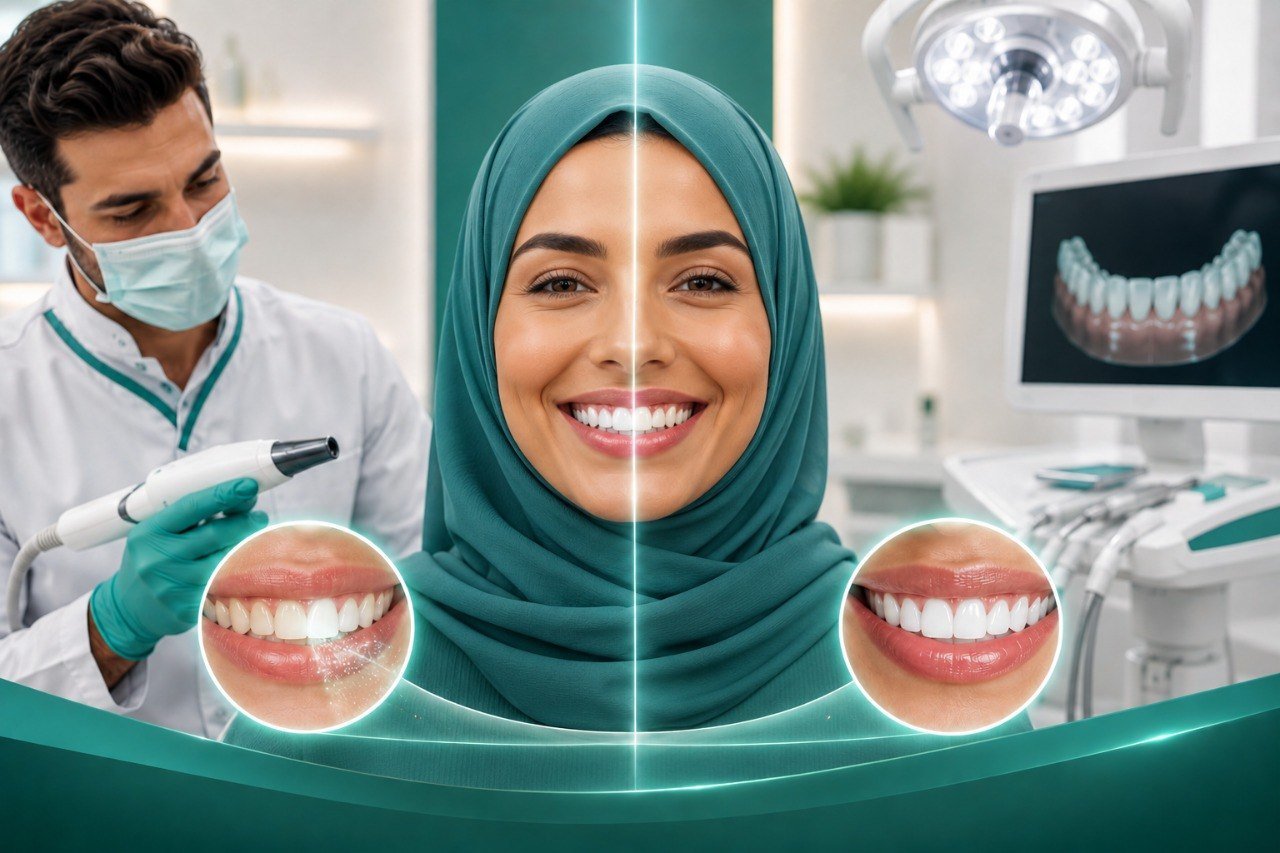
Your teeth might be well-aligned and nicely shaped, but their color has become darker because of coffee, tea, or smoking. In another case, the color might be fine, but you're not comfortable with the shape of your teeth, the gaps, chips, or size differences.
This is where the question comes in:
Is teeth whitening enough, or do I need a Hollywood smile?
The core difference is simple:
Teeth whitening focuses on lightening the color of your natural teeth, while a Hollywood smile is a broader cosmetic plan that may address color, shape, size, gaps, and the alignment of the teeth.
Not everyone who wants a more beautiful smile needs veneers or crowns. Sometimes cleaning and whitening the teeth is enough, and sometimes the problem is broader and needs cosmetic fillings, braces, veneers, or a crown for a specific tooth.
What matters is that the plan starts from an exam of the teeth and gums and identifying the problem, not from choosing the procedure's name before visiting the doctor.
The dental department at Rawnaq Medical Complex offers teeth whitening, cosmetic fillings, veneers and lumineers, braces, fixed prosthodontics, and dental implants, alongside other treatment services.
The Direct Answer
If your teeth are healthy and well-aligned, and the main problem is yellowing or staining, whitening may be the simplest option and the most conservative for the teeth. If the problem includes gaps, chips, the shape or size of the teeth, or their alignment, you may need a comprehensive smile makeover plan.
The right plan can't be determined from a photo on your phone or an ad, because the doctor needs to evaluate:
- The health of the teeth and gums.
- Presence of decay or infections.
- The cause of the color change.
- Presence of old fillings or crowns.
- The alignment and bite of the teeth.
- The condition of the tooth enamel.
- Presence of grinding or clenching.
- The shape the client wants.
Quick Comparison: Whitening vs. Hollywood Smile
- Goal: lighten the color of the natural teeth
- Doesn't change the shape of the teeth
- Treatment duration is usually shorter
- Doesn't change the tooth's shape (a conservative option)
- Goal: improve color, shape, and harmony
- A plan that may include one or several procedures
- Duration varies depending on the number of procedures
- Some procedures aren't fully reversible
| Comparison Point | Teeth Whitening | Hollywood Smile |
|---|---|---|
| Primary goal | Lighten the natural teeth's color | Improve color, shape, and harmony |
| Nature of the procedure | Using dedicated whitening agents | A plan that may include one or several procedures |
| Changing the shape of the teeth | No | Possible depending on the plan |
| Closing gaps | No | Possible with veneers, fillings, or braces |
| Repairing chipped teeth | No | Possible depending on the size of the chip |
| Adjusting tooth alignment | No | May need braces |
| Changing the color of crowns and fillings | No | Old restorations may need replacing |
| Preparing or filing the teeth | Not usually needed | May be required with some types of veneers or crowns |
| Treatment duration | Usually shorter | Varies depending on the number of procedures |
| Reversibility | Doesn't change the tooth's shape | Some procedures aren't fully reversible |
- Whitening changes the color of the teeth but not their shape.
- A Hollywood smile isn't a single medical procedure.
- Not every Hollywood smile means veneers or crowns for all the teeth.
- Whitening doesn't change the color of fillings, crowns, or veneers.
- A veneer covers the front surface of the tooth.
- A crown covers the entire tooth and is often used when the tooth needs protection or restoration.
- Whitening doesn't treat gaps, chips, or crowding.
- Decay and gum inflammation must be treated before cosmetic work.
- The whitest shade isn't always the most suitable one.
- Preserving natural teeth is a priority whenever possible.
What Is Teeth Whitening?
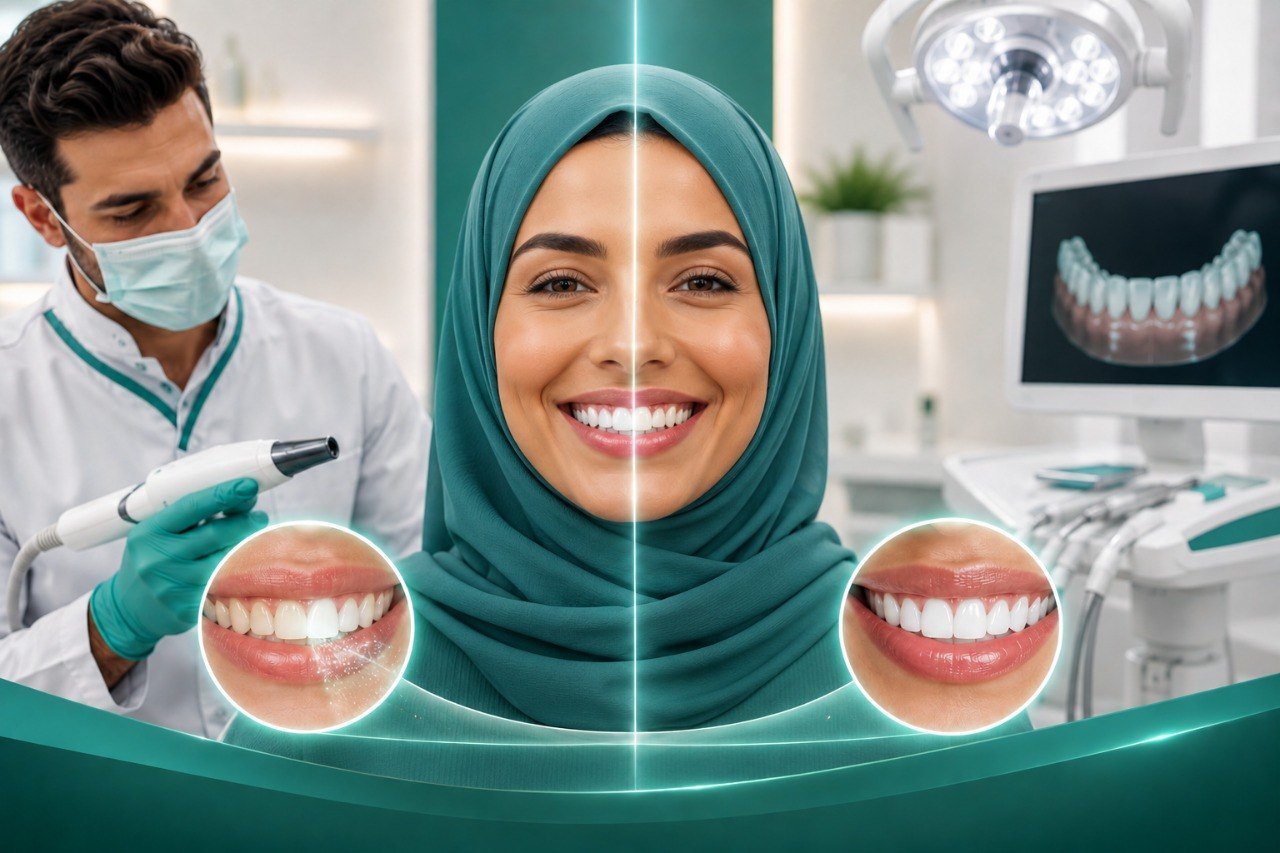
Teeth whitening is a cosmetic procedure that uses agents usually containing hydrogen peroxide or carbamide peroxide. These agents help break down stains into smaller particles, making the teeth's color brighter. Whitening can be done in several ways:
In-Office Whitening
The doctor protects the gums first, then applies the whitening agent to the teeth at the concentration and duration suitable for the case. Whitening may be done in one visit or more depending on:
- The teeth's baseline color.
- The cause of the staining.
- The degree of sensitivity.
- The system used.
- The realistic result desired.
Doctor-Supervised At-Home Whitening
The doctor prepares custom trays that fit the teeth, and specifies for the client:
- The amount of agent used.
- How long to wear the tray.
- The number of days.
- How to handle sensitivity.
- When to stop using it.
The American Dental Association explains that doctor-supervised at-home whitening is done using a custom tray and clear instructions, and may take several days to weeks depending on the program.
Stain-Removing Toothpaste
Some toothpastes help remove external stains from the surface of the teeth, but they don't change the internal color the same way whitening agents do. This means they may help with surface coffee and tea stains, but they aren't a full substitute for medical whitening when the goal is changing the shade of color.
Why Does Tooth Color Change?
Tooth color changes over time for various reasons, including:
- Coffee.
- Tea.
- Smoking.
- Certain colored foods and drinks.
- Aging.
- A previous injury to the tooth.
- Certain medications.
- Thinning enamel that makes the dentin's color more visible.
The American Dental Association explains that coffee, tea, and some drinks contain pigments that stick to tooth enamel, and that the tar and nicotine resulting from tobacco use cause dark or yellow stains.
Does Whitening Suit All Tooth Colors?
No. The degree of response depends on the cause and color of the staining. Usually:
- Teeth with a yellow tone may respond better.
- Brown stains may respond less.
- Gray teeth may not respond noticeably.
- A single tooth's color change due to injury may need a different treatment.
- Staining caused by certain medications may not improve with conventional whitening.
For this reason, it's best for the doctor to examine the teeth before whitening instead of buying a product and trying it randomly.
What Can Whitening Do?
Whitening may help:
- Lighten the color of the natural teeth.
- Reduce some stains caused by coffee and tea.
- Improve age-related yellowing.
- Make the smile brighter.
- Even out the natural teeth's color to a better degree.
But the result varies from person to person, and there's no single whiteness level guaranteed for everyone.
What Can't Whitening Do?
Teeth whitening cannot:
- Change the shape of the teeth.
- Enlarge small teeth.
- Shorten long teeth.
- Close gaps.
- Straighten crooked teeth.
- Repair chipped teeth.
- Treat decay.
- Treat gum inflammation.
- Change the color of veneers.
- Change the color of crowns.
- Change the color of cosmetic fillings.
- Adjust the color of artificial restorations.
Whitening agents work on natural teeth, but they don't lighten the color of fillings, crowns, or ceramic veneers. This can lead to a visible color difference if the teeth are whitened while old restorations are left as they are.
What Does "Hollywood Smile" Mean?
Hollywood smile, or celebrity smile, is a common cosmetic term, not the name of one fixed procedure. Practically, it refers to putting together a plan to improve the appearance of the smile, which may include:
- Teeth cleaning.
- Teeth whitening.
- Cosmetic fillings.
- Veneers.
- Lumineers.
- Dental crowns.
- Braces.
- Dental implants.
- Adjusting old restorations.
- Gum treatment before cosmetic work.
Rawnaq's official website lists these services under the dentistry and cosmetic dentistry section, including whitening, cosmetic fillings, veneers, lumineers, braces, prosthodontics, and implants.
This means one person's "smile plan" might be just cleaning and whitening, while another needs braces, and a third needs to restore a chipped tooth or replace an old crown.
Does a Hollywood Smile Mean Veneers on All the Teeth?
No. The number of teeth that need treatment depends on:
- The number of teeth visible when smiling.
- The width of the smile.
- The condition of each tooth.
- Presence of previous fillings or crowns.
- The color of the teeth.
- Their alignment.
- The bite.
- The shape of the face and lips.
- The desired result.
Sometimes a person doesn't need any veneers at all, and whitening, cosmetic fillings, or braces are a more conservative option.
Not every natural tooth needs to be covered for the smile to look better.
What Is a Veneer?
A veneer is a custom cosmetic shell that covers the front surface of the tooth. It may be used to improve the appearance of teeth suffering from:
- A noticeable color change.
- A chip or crack.
- A difference in shape.
- Limited gaps.
- An inconsistency in size.
- A cosmetic flaw that whitening isn't enough to treat.
The American Dental Association explains that a veneer covers only the front of the tooth, unlike a crown, which covers the entire tooth structure.
Does a Veneer Require Filing the Teeth?
In many cases of ceramic veneers, the doctor removes a limited amount of enamel from the front and sides of the tooth so the veneer fits the shape of the teeth and the bite. This is why the treatment is often not fully reversible once part of the enamel has been removed. The amount of preparation depends on:
- The position of the teeth.
- How much they protrude.
- Their color.
- The thickness of the veneer.
- The type of material.
- The desired result.
- The bite.
Because of this, we can't tell every client "there's absolutely no filing" before the exam.
What's the Difference Between a Veneer and a Crown?
| Comparison Point | Veneer | Crown |
|---|---|---|
| Part covered | The front surface of the tooth | The entire tooth |
| Primary goal | Improve shape and color | Protect and restore the tooth and improve its shape |
| Tooth preparation | Usually less | Often greater |
| Used for | Relatively healthy teeth with a cosmetic problem | Weak or chipped teeth, or teeth with a large filling |
| Strengthening the tooth | Not its primary function | May help protect a weak tooth |
| Changing color and shape | Yes | Yes |
A crown may be used when the tooth is:
- Weak.
- Chipped.
- Has a large filling.
- Treated in a way that needs protection.
- Unable to hold an additional filling.
- An implant that needs a crown placed on top.
The American Dental Association explains that a crown may strengthen a tooth that has lost a significant part of itself, protect a weak tooth, or rebuild a chipped tooth.
When Is Whitening Enough?
Whitening may be suitable if:
- The alignment of the teeth is acceptable.
- The shape of the teeth is consistent.
- There are no bothersome gaps.
- There are no chips that need restoration.
- The teeth and gums are healthy.
- The main problem is the color.
- The cause of the staining is responsive to whitening.
- You want a conservative option that doesn't change the shape of the teeth.
A Simple Example
If your teeth are well-aligned, and you don't have noticeable chips or gaps, but their color has become yellow due to coffee or smoking, cleaning and whitening may be enough to make a clear difference.
When Isn't Whitening Alone Enough?
You may need a different plan if you have:
- Gaps between the teeth.
- A chip in a front tooth.
- Small or inconsistent teeth.
- Old front fillings.
- An old crown with a different color.
- Crowding or tilting of the teeth.
- Tooth wear.
- Severe internal staining.
- A single dark tooth due to injury or previous treatment.
- A significant difference in tooth sizes.
- A gum or bite problem.
In these cases, repeating whitening may not solve the problem, because color isn't the only cause.
Is a Veneer the Only Solution for Gaps?
Not always. Gaps can be dealt with in several ways, depending on the cause and size, such as:
- Braces.
- Cosmetic fillings.
- Veneers.
- Replacing a missing tooth.
- Treating a gum or bite problem.
If the gap results from the alignment of the teeth, braces may be the more conservative option instead of covering healthy teeth.
Is a Veneer a Substitute for Braces?
In some simple cases, a veneer may improve the outward appearance of an inconsistent tooth, but it doesn't move the tooth roots or correct bite problems. If there is:
- Noticeable crowding.
- Protruding teeth.
- An incorrect bite.
- A jaw problem.
- Significant rotation of the teeth.
Braces may be more suitable, or may be included in the plan before cosmetic work. The dental department at Rawnaq offers metal, clear, lingual, and invisible braces options alongside cosmetic services.
Can Whitening Be Done Before a Veneer or Crown?
Yes, the doctor may suggest whitening the natural teeth first, then choosing the veneer or crown color once the shade has stabilized. The reason is that artificial restorations don't respond to whitening agent applied later.
Example: if you have one crown on a front tooth and you whiten the rest of your teeth, the crown's color may end up darker than the natural teeth. The treatment sequence must therefore be planned from the start.
Do I Need to Clean My Teeth Before Whitening?
Some clients may need to have tartar and stains cleaned before whitening. Cleaning helps remove:
- Tartar.
- Plaque.
- Surface stains.
- Deposits around the teeth and gums.
Whitening, on the other hand, works to lighten the color of the natural teeth. Not everyone needs both procedures on the same day, and the doctor determines the priority based on the condition of the gums and teeth.
Does Teeth Whitening Cause Sensitivity?
Whitening may cause temporary sensitivity in some people. Sensitivity occurs when the whitening agent passes through the enamel to the dentin layer and causes temporary irritation of the nerve. In most cases, sensitivity eases after stopping the treatment or adjusting the method. You should tell the doctor if you have:
- Previous sensitivity.
- Pain in one of your teeth.
- Gum recession.
- Cracks.
- Exposed roots.
- Decay.
- Loose fillings.
- Pain with cold or hot.
You shouldn't have to endure severe pain for the sake of reaching a lighter shade.
Does Excessive Whitening Harm the Teeth?
Using whitening products excessively or contrary to instructions may cause:
- Increased sensitivity.
- Gum irritation.
- Pain.
- Damage to the enamel or surrounding tissue.
- An uneven result.
The American Dental Association warns against overusing whitening agents and recommends following instructions and discussing options with a dentist.
How Long Does the Whitening Result Last?
The result isn't permanent. The color may change again due to:
- Coffee.
- Tea.
- Smoking.
- Colored drinks.
- Certain foods.
- Not cleaning the teeth.
- The nature of the enamel.
- Aging.
The result can be maintained through:
- Cleaning the teeth regularly.
- Using floss or cleaning between the teeth.
- Reducing smoking and colored drinks.
- Rinsing with water after coffee.
- Regular visits to the doctor.
- Using a follow-up program if prescribed by the doctor.
Does a Veneer Last a Lifetime?
No veneer is guaranteed for life. Over time it may experience:
- Breaking.
- Cracking.
- Detaching.
- Wear.
- A change in the gum edges.
- The need for repair or replacement.
Decay can also occur around the veneer or under its edges if the teeth and gums aren't properly cared for. The American Dental Association recommends brushing with fluoride toothpaste and cleaning between the teeth, while avoiding biting nails and hard objects.
What Color Is Suitable for a Hollywood Smile?
The suitable color isn't always the whitest shade available on the shade guide. The color should match:
- Skin tone.
- The client's age.
- Eye color.
- Gum color.
- The shape of the face.
- The neighboring teeth.
- The number of teeth that will be treated.
- The expected natural look.
Very white teeth may look unnatural if they don't match the rest of the facial features, or if some teeth's color is changed while others are left as they are.
The better goal is a harmonious, natural-looking smile, not just the highest whiteness level.
Is There a Hollywood Smile Without Filing?
Some cases may be suitable for minimal-preparation techniques, but this isn't suitable for everyone. The ability to reduce preparation depends on:
- The size of the teeth.
- How much they protrude.
- The gaps.
- The original color.
- The thickness of the veneer.
- The bite.
- The desired result.
Placing veneers without enough space may make the teeth look:
- Thick.
- Protruding.
- Long.
- Unnatural.
Therefore, a "smile without filing" cannot be guaranteed before the exam.
What Exams Are Required Before a Smile Makeover?
The evaluation stage may include:
Decay and gum infections must be treated before placing veneers, because placing veneers over unhealthy teeth may make the problem worse.
How Do You Choose Between Whitening and a Hollywood Smile?
Whitening may suit you if your goal is:
- Lightening the color only.
- Preserving the natural shape of the teeth.
- Avoiding tooth preparation.
- Improving coffee or smoking stains.
- Getting a simpler procedure.
- Preserving as much tooth enamel as possible.
You may need a comprehensive smile plan if your goal is:
- Closing gaps.
- Repairing chips.
- Adjusting the shape of the teeth.
- Evening out sizes.
- Changing old restorations.
- Treating crowding or protrusion.
- Replacing missing teeth.
- Dealing with more than one problem at the same time.
You may need treatment first if you have:
- Decay.
- Bleeding or gum inflammation.
- Tooth pain.
- An abscess.
- Bad breath caused by a treatable problem.
- Loose teeth.
- Heavy tartar buildup.
- A bite problem.
- Teeth grinding.
- A chipped or weak tooth.
Common Mistakes When Requesting a Hollywood Smile
- Choosing the color from a celebrity photo.
- Requesting veneers for all teeth without an exam.
- Placing crowns on healthy teeth without need.
- Starting cosmetic work before treating decay.
- Ignoring gum health.
- Expecting whitening to change the color of restorations.
- Choosing the whitest color without considering the face.
- Not asking about the amount of tooth preparation.
- Ignoring teeth grinding.
- Choosing the procedure based on the offer alone.
- Assuming a Hollywood smile is one fixed service.
- Expecting a veneer to need no maintenance or replacement.
Common Myths About Teeth Whitening & the Hollywood Smile
Frequently Asked Questions
Teeth Whitening & Cosmetic Dentistry Services at Rawnaq Medical Complex
The dental department at Rawnaq offers services including:
- Teeth whitening.
- Teeth cleaning.
- Cosmetic fillings.
- Veneers.
- Lumineers.
- Metal braces.
- Clear braces.
- Lingual braces.
- Invisible braces.
- Fixed and removable prosthodontics.
- Crowns and bridges.
- Dental implants.
- Treating gapped, crowded, and discolored teeth.
Available services and dentists' appointments vary by branch, so the service should be confirmed when booking.
Contact the Al Olaya branch in Khobar to inquire about teeth whitening and cosmetic dentistry services and available appointments.
Contact the Ishbiliya branch in Khobar to inquire about teeth whitening and cosmetic dentistry services and available appointments.
Contact the Seihat branch to inquire about teeth whitening and cosmetic dentistry services and available appointments.
Don't Choose the Procedure's Name Before Identifying Your Goal
Before booking, ask yourself:
- Is the problem just the color?
- Do I have gaps or chips?
- Are there old fillings or crowns?
- Is the shape of my teeth inconsistent?
- Are my teeth crowded or protruding?
- Do I want to preserve my teeth without preparation?
- Am I looking for a simple change or a comprehensive plan?
- Is the result I want natural and suitable for my face?
Then discuss with the doctor the options that are most conservative for the teeth, the amount of preparation required, and aftercare and maintenance.
Start with an Exam and Choose Your Nearest Branch
Identify your goal and the condition of your teeth, and contact the nearest branch to learn about teeth whitening and cosmetic dentistry services and available appointments.
Medical Notice: This article provides general educational information and does not replace a dentist's examination. The suitable procedure varies depending on the health of the teeth and gums, the cause of the color change, the bite, existing restorations, and the goal of treatment.
Medical & Official Sources
- American Dental Association: Teeth whitening, its options, and side effects.
- American Dental Association: Veneers, how they're placed, and their care.
- American Dental Association: Dental crowns and their therapeutic uses.
- Rawnaq Medical Complex Official Website: Dentistry and Cosmetic Dentistry department services.