
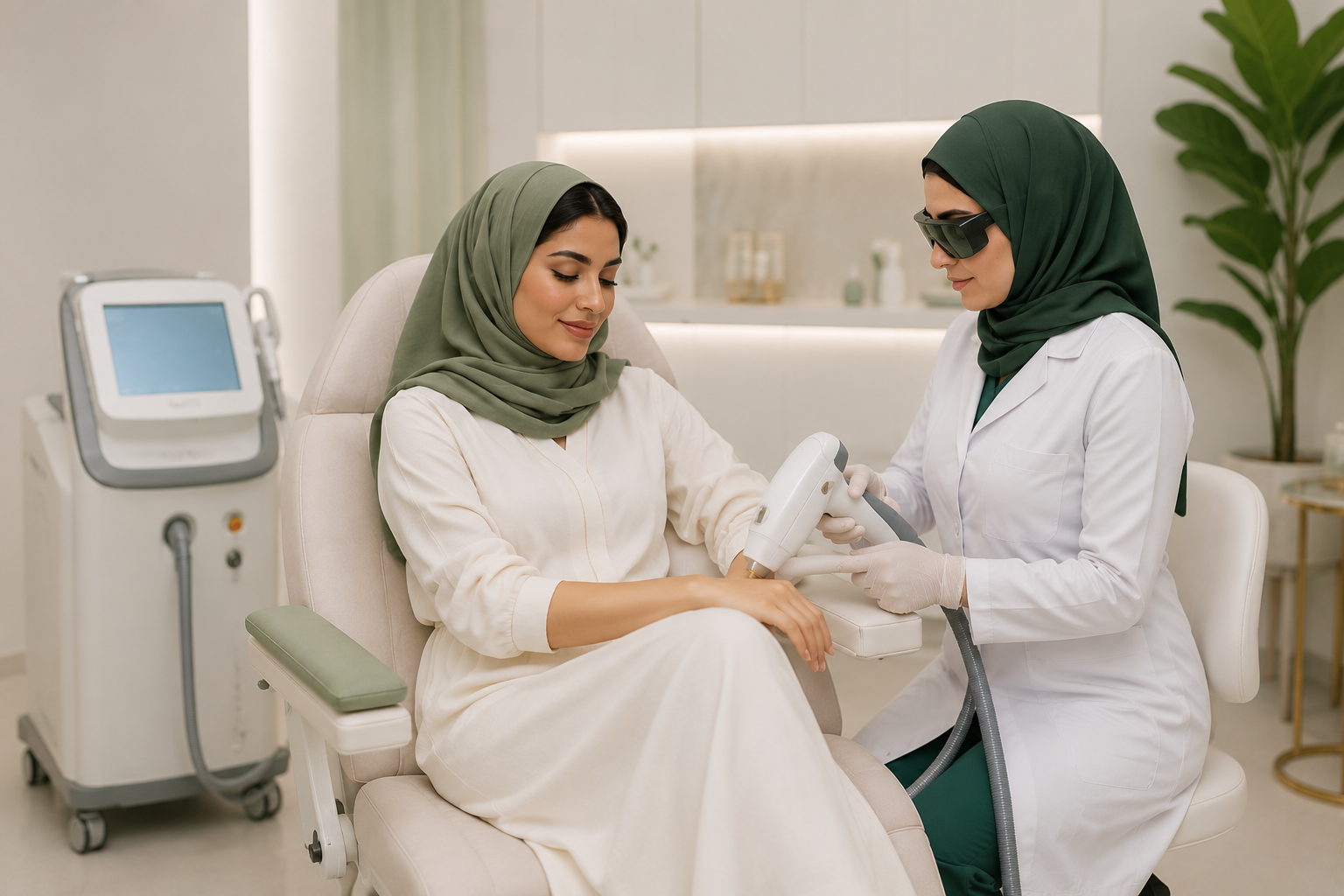
When thinking about reducing hair growth, you may be torn between buying a device for home use or booking laser sessions at a specialized clinic.
Many home devices are called home laser, but a large number of them actually rely on Intense Pulsed Light (IPL) technology, which is a light technology different from the laser rays used in many professional devices inside clinics.
Both methods can help reduce hair growth, but they differ in device power, method of use, speed of results, the extent of the need for assessment and follow-up, and how suitable each technology is for the skin tone and hair color.
Laser hair removal services for women are available at the four Rawnaq Medical Complex branches:
- Al Olaya Branch – Khobar.
- Ishbiliya Branch – Khobar.
- Seihat Branch.
- Abqaiq Branch.
Read Also
Laser Hair Removal for Women in the Eastern Province: Your Guide Before the First Session.
The Direct Answer
Home devices are suitable for those looking for an option that can be used on their own and regularly at home, and may help reduce hair growth with commitment. Clinic devices, on the other hand, are used by a trained team, allow assessment of the skin and hair and the choice of customized settings, and are often more suitable for large areas, thick hair, or cases that need more organized follow-up.
There is no single option that is best for all women. The choice depends on:
- Skin tone.
- Hair color and thickness.
- The required area.
- Hair density.
- The ability to commit repeatedly.
- The presence of medications or skin conditions.
- Expectations of the result.
- The need for specialized assessment and follow-up.
Quick Comparison Between Home Laser and Clinic Laser
- Mostly IPL, some low-power laser
- Self-use at home
- Usually lower power, designed for home
- Follow-up is the user's responsibility
- Professional laser or light devices with multiple settings
- Performed by a trained team
- Higher power, adjustable per case
- Follow-up and documentation of response
| Comparison Point | Home Devices | Clinic Sessions |
|---|---|---|
| Technology | Mostly IPL, some use light-based technologies or low-power laser | Professional laser or light devices with multiple technologies and settings |
| Use | Self-use at home | Performed by a trained team |
| Power level | Usually lower, designed for home use | Higher, adjustable per case |
| Assessment | Relies on the device's instructions and the user | Assessment of skin, hair, and medical history |
| Session speed | May take longer for large areas | Relatively faster depending on the device and area |
| Frequency of use | Needs repeated commitment per the device's instructions | Spaced-out appointments according to the hair growth cycle |
| Result | Gradual reduction that needs continuation | Gradual reduction through an organized session program |
| Follow-up | The user's responsibility | Follow-up and documentation of response |
| Cost | Initial purchase cost, then repeated use | Cost per session or package |
| Suitability for the case | Limited by the device's instructions and specifications | Technology and settings can be adjusted based on assessment |
Is a Home Device Actually a Laser?
Not always.
Many home hair removal devices use Intense Pulsed Light – IPL technology, which emits a range of light, while a laser device uses a more specific wavelength.
US FDA documents classify a number of over-the-counter home devices as IPL devices intended to reduce hair, not to remove it permanently. There are also some home devices that use low-power laser, so it's important to read the device's actual specifications instead of relying only on the marketing name.
This is why you may find a product advertised as "home laser," while the technology listed in the device's manual is IPL.
How Do Home Hair Removal Devices Work?
Home devices emit light pulses that are absorbed by the pigment present in the hair. The energy turns into heat that affects the follicle and helps reduce hair growth speed with repeated use.
These devices are usually designed with relatively low power to suit self-use. Studies have shown that low-power home devices can achieve a reduction in hair growth when used regularly and according to the instructions, but the amount of the result varies between devices and users.
This means a home device can be useful, but it requires:
- Choosing a device suitable for the skin and hair.
- Correct and regular use.
- Committing to the manufacturer's schedule.
- Covering all parts of the area accurately.
- Continuing use to maintain the result.
- Following all the warnings written in the manual.
How Do Laser Sessions Work at Clinics?
At the clinic, a professional device is used to send light energy that targets the pigment present in the hair and affects its follicle. Before or during the program, factors such as the following are taken into account:
- Skin tone.
- Hair color and thickness.
- Hair density.
- The treated area.
- Sun exposure or tanning.
- Response to previous sessions.
- Medications and health condition.
- The presence of inflammation or irritation in the area.
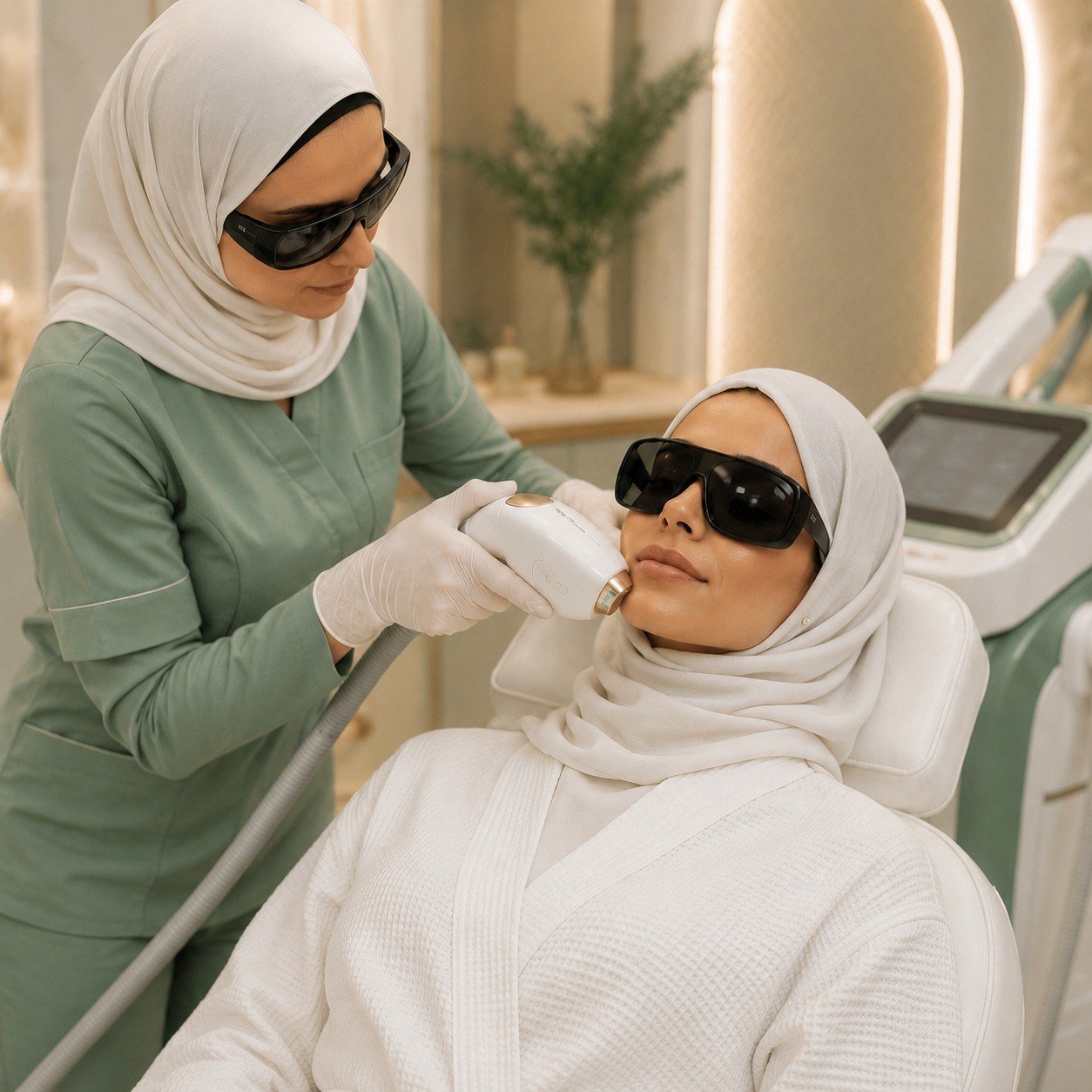
Clinic devices allow choosing different settings according to the case, and many devices also provide cooling systems to help protect the skin and reduce discomfort.
Are Clinic Laser Results Faster?
Results at clinics may appear clearer or faster for many cases, because professional devices operate with higher, customizable settings, and because the session is performed by a trained team. But this does not mean:
- That hair will disappear from a single session.
- That the result will be permanent for everyone.
- That the highest energy gives the best result.
- That all areas respond at the same speed.
Clinic sessions also need a multi-session program, because not all hairs are in the same growth phase. The American Academy of Dermatology indicates that hair removal may need six sessions or more, with the possibility of retreatment when hair grows back.
Read Also
How Many Laser Sessions Does the Body Need? Session Count, Intervals & Expected Results.
Is Home Laser Effective?
Some home devices can help reduce the number and thickness of hairs with regular use, and studies have shown positive results for a number of users. But results vary depending on the device, the energy used, skin and hair color, and adherence to the method of use.
The available scientific evidence is also not equal for all products on the market. A scientific review has pointed to the limited strong randomized trials supporting all home laser and light devices, so the result of one specific device cannot be generalized to all devices carrying the same name.
So it's important to distinguish between:
- The existence of studies on a specific home technology.
- The existence of an authorization or registration for a specific device.
- Commercial advertising for the product.
- Another person's experience on social media.
What Are the Advantages of Home Devices?
Privacy
Sessions can be performed at home, which may be suitable for those who prefer privacy or cannot visit the clinic regularly.
Time Flexibility
The device can be used at a convenient time, according to the schedule and instructions set by the manufacturer.
One-Time Purchase Cost
After buying the device, there is usually no separate cost per use, except for maintenance or replacing parts if the device requires it.
Suitability for Maintenance Sessions
Some women may use a home device to maintain the result or deal with limited hair after completing professional sessions, provided the device's suitability is confirmed and its use does not conflict with the clinic's plan.
What Are the Disadvantages of Home Devices?
The Need for Repeated Commitment
Home devices usually need more frequent use according to each device's instructions, and the user may not get the desired result if she does not stick to the schedule.
Difficulty Covering Large Areas
Treating the legs or body may take time, and overlap may occur or parts may be left without the device being passed over them correctly.
Difficulty Reaching Some Areas
Using the device may be difficult on the back or other parts that cannot be easily seen or reached.
Possibility of Incorrect Use
Using an unsuitable setting, repeating flashes, or violating the instructions may lead to redness, irritation, burns, or a change in skin color. A survey study found limited side effects among some home device users, including redness, bumps, burns, and color change.
Variation in Device Quality
Not all devices on the market are equal in quality, testing, or instructions. It's important to check the manufacturer, the device's specifications, the instructions for use, and how suitable it is for the skin tone and hair color.
What Are the Advantages of Laser Sessions at Clinics?
Assessing the Case Before the Session
The skin tone, hair nature, medical history, and medications can be reviewed before choosing the settings.
Choosing Customized Settings
The device is adjusted based on the area and response, instead of relying on limited or generic home settings.
Treating Large Areas
Professional devices are suitable for treating the legs or the full body during an organized appointment.
The Presence of Follow-Up
Sessions can be documented, the response reviewed, and the plan adjusted when needed.
Dealing With Different Skin Tones
It has become possible to treat different skin tones using the appropriate technology and expertise, but choosing the correct settings remains important to reduce the likelihood of burns or color change.
Quick Detection of Abnormal Reactions
The session can be stopped or the settings adjusted when severe pain or an unexpected skin reaction appears.
What Are the Disadvantages of Clinic Sessions?
The Need to Attend
Sessions require committing to appointments and visiting the branch.
Repeated Cost
The cost of sessions or the package is paid, and the case may need additional sessions or follow-up.
Variation in Facility Standards
Visiting any place that offers a laser service does not mean the service will be suitable or safe. It's important to confirm the facility's license, the team's training, the safety of the devices, and the clarity of instructions and follow-up.
The Need to Organize Appointments
Repeated delays or not attending may prolong the program, even with a professional device.
Which Is Safer?
Both methods can be safe when a suitable device is used and instructions are followed, but the nature of safety differs.
With a home device, safety relies heavily on:
- The accuracy of the product's information.
- The device's suitability for the skin.
- Reading the instructions manual.
- Not exceeding the settings.
- Not using it on prohibited areas.
- Stopping when an abnormal reaction appears.
At the clinic, safety relies on:
- The team's experience.
- Assessment of skin and hair.
- Choosing the device and settings.
- Eye protection.
- Cooling.
- Monitoring the skin's reaction.
- Following pre- and post-session instructions.
The potential risks of laser hair removal include skin irritation and temporary or persistent changes in skin color, with increased risk when exposed to the sun or using unsuitable settings.
Which Is More Suitable for Dark Skin?
Not all home devices are suitable for all skin tones. Some devices have a skin tone sensor or prevent the flash when suitable contact isn't available, but skin tone limits vary from one device to another.
At the clinic, the skin tone can be assessed and the appropriate technology and settings chosen, so professional sessions may be a more organized option for dark or tanned skin, or skin that has previously experienced pigmentation or burns.
But having the device inside a clinic alone isn't enough; expertise and correct operation must also be available.
Which Is More Suitable for Light Hair?
Laser and IPL technologies rely on the presence of pigment inside the hair. Therefore, the response may be limited in:
- White hair.
- Gray hair.
- Very light blonde hair.
- Light red hair in some cases.
Success of a home device or a clinic device cannot be guaranteed for these colors. A device should not be bought, or a package booked, based on general promises before knowing how suitable the hair color is for the technology.
Is a Home Device Suitable for the Face?
This depends on the device's instructions and the area it's allowed to be used on.
Some devices allow use on specific areas of the face, while other devices prohibit getting close to the eyes, eyebrows, or certain parts. So it's important to refer to the device's manual and not use it on an unapproved area.
A woman's facial hair may also be affected by hormonal factors, and may need longer follow-up or medical assessment if its growth is dense or sudden. The American Academy of Dermatology explains that the result of laser hair removal on a woman's face may not be permanent due to the effect of hormones.
Can a Home Device Be Used for the Full Body?
Some home devices can be used on multiple areas, but doing the full body may take time and require accuracy in covering every part. Before use, you should confirm:
- The areas the device allows.
- The suitable skin tone.
- The suitable hair color.
- The interval between uses.
- The allowed age.
- Prohibited conditions and medications.
- How to protect sensitive areas.
- The device's cleaning and maintenance instructions.
At the clinic, several areas can be treated within a single appointment, with the body divided and suitable settings chosen for each area.
Rawnaq Medical Complex offers services for individual areas and full-body options with or without the back and abdomen, according to the service booked at the four branches.
Can a Home Device Be Combined With Clinic Sessions?
Some women may use a home device between clinic programs or after finishing them, but the two methods should not be combined randomly. Unorganized use may lead to:
- Skin irritation.
- Difficulty assessing the response.
- Exposing the area to light at an unsuitable time.
- Changing the professional session's timing.
- Not knowing the cause of any skin reaction that appears.
If you are already using a home device, tell the clinic team before starting sessions and specify:
- The device's name.
- The technology used.
- The last date it was used.
- The areas that were treated.
- Any irritation or change that occurred.
When Is a Home Device a Suitable Option?
It may be suitable when:
- Your hair and skin are within the device's allowed tones.
- You can commit repeatedly to the instructions.
- The areas are easy to reach.
- The hair is limited or medium density.
- You prefer performing sessions at home.
- There is no skin condition or medication requiring assessment.
- Your expectations about the speed of results are realistic.
When Are Clinic Sessions More Suitable?
A clinic may be more suitable when:
- The area is large, such as the full body.
- The hair is dense or thick.
- The skin needs precise assessment.
- The skin is dark or has recently been tanned.
- There is a previous experience with burns or pigmentation.
- A home device didn't achieve the desired result.
- The area is difficult to reach.
- There are medications or a skin condition that must be disclosed.
- You need a documented program and appointments.
- Facial or body hair appears suddenly or unusually.
How Do You Choose a Home Device?
Before buying, review:
- The manufacturer's name.
- The actual technology: IPL or laser.
- The approved skin tones.
- The suitable hair colors.
- The areas the device is allowed to be used on.
- The number of flashes or the operational lifespan.
- The presence of a skin and contact sensor.
- Eye protection instructions.
- Warnings and contraindications.
- Warranty and maintenance.
- The party that sold the device.
- The existence of a trusted registration or authorization for the device itself.
Don't rely only on:
- The number of reviews.
- Promotional photos.
- An influencer's experience on social media.
- The phrase "approved" without a number or reference.
- Promises such as a final result or no pain.
- An undocumented hair reduction percentage.
The existence of an authorization for a specific device does not mean that all similar devices, or those using the same name, hold the same authorization.
How Do You Choose a Suitable Clinic for Laser Sessions?
Check that:
- The facility is medical and licensed.
- The team performing the session is trained.
- The laser room is clean and well-prepared.
- Medications and health condition are reviewed.
- Instructions are clear before and after the session.
- Eye protection is available.
- Suitable cooling is available.
- Sessions and settings are recorded.
- There is a mechanism to handle complaints or reactions.
- No promises of guaranteed results are made.
- The areas included in the booking are clear.
Common Myths
Frequently Asked Questions
Laser Sessions at Rawnaq Medical Complex Branches
Laser hair removal services for women are available at the four Rawnaq Medical Complex branches, according to the services and appointments available at each branch.
Contact the Al Olaya branch in Khobar to learn about the available services and appointments for laser hair removal for women.
Contact the Ishbiliya branch in Khobar to learn about the available services and appointments for laser hair removal for women.
Contact the Seihat branch to learn about the available services and appointments for laser hair removal for women.
Choose the Option Right for You
Home laser isn't useless, and clinic sessions aren't a magic solution that suits everyone. A home device relies on your ability to choose a trustworthy device and commit to correct, repeated use. A clinic, on the other hand, offers assessment, customized settings, and a more organized program, and may be more suitable for large areas, dense hair, or cases that need follow-up.
Medical Disclaimer: This article provides general educational information and does not replace medical assessment, a specialist's instructions, or the manual of the device used. The suitability of home hair removal devices and clinic sessions varies according to skin tone, hair color, health condition, medications, and the treated area.