
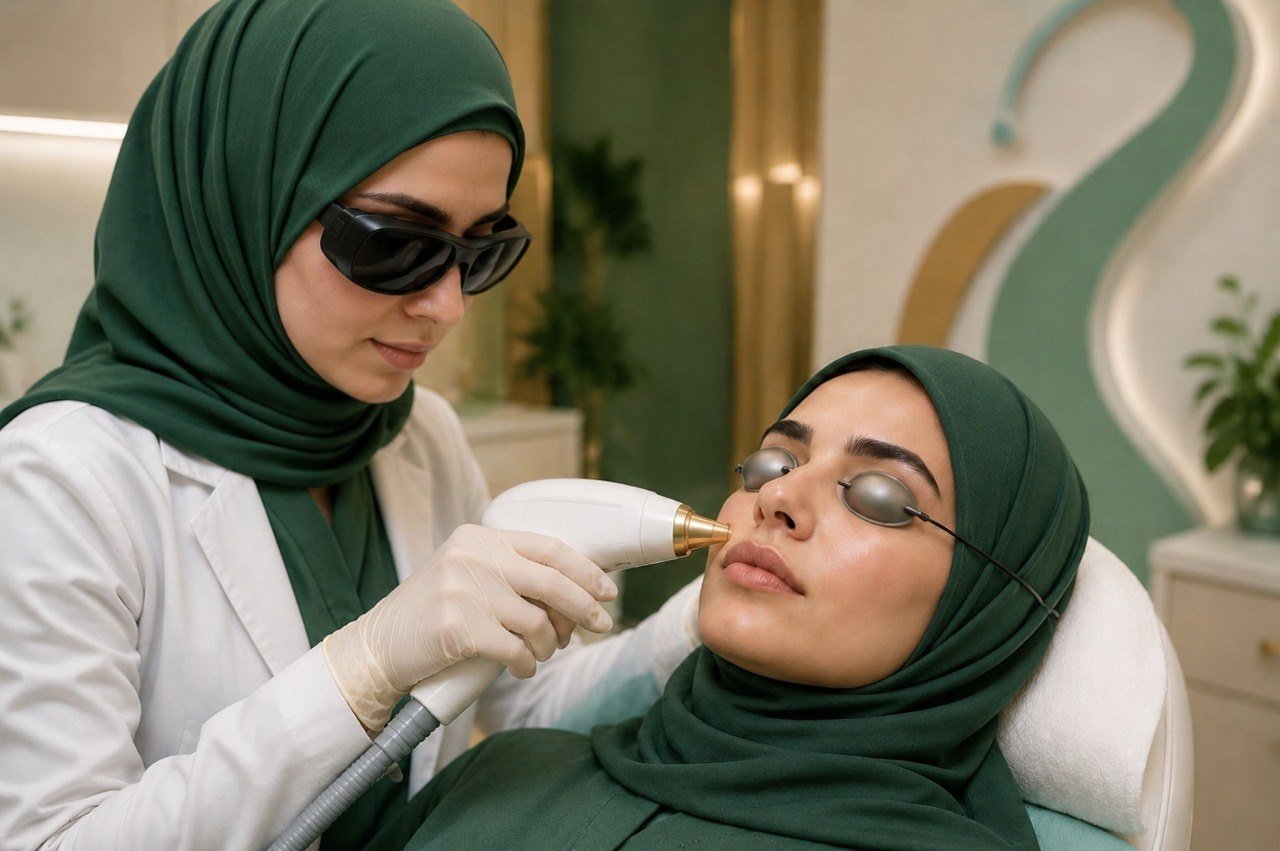
Laser face and eyebrow bleaching helps make dark hairs less visible by lightening their pigment, but it does not remove the hair or target the follicle the way laser hair removal sessions do.
The core difference is simple:
Bleaching changes the color of the hair so it becomes less visible, while laser hair removal aims to affect the follicle and reduce hair growth with repeated sessions.
Bleaching may be suitable for fine hairs that the client doesn't want to remove, or for facial and eyebrow hair that stands out because of its dark color. Thick or dense hair that the client wants to reduce, on the other hand, may need to be evaluated for the hair removal option instead of bleaching.
Face and eyebrow bleaching services are available among the skin device services at the branches of Rawnaq Medical Complex, according to the appointments and services active at each branch.
You Might Also Like
A guide to laser hair removal before your first session.
The Direct Answer
Laser hair bleaching is a cosmetic procedure that aims to lighten the color of the hair and make it less visible, while the hair and follicle remain in place. Laser hair removal, on the other hand, targets the pigment in the hair to carry energy to the follicle and gradually reduce hair growth.
Recent studies have used Q-switched Nd:YAG laser at a wavelength of 1064 nm to lighten facial and body hair, showing the ability to lighten hair with an acceptable level of safety when the procedure is performed under specialist supervision. However, the degree of lightening and how long the result lasts vary depending on the hair's color, nature, and new hair growth.
Quick Comparison: Bleaching vs. Hair Removal
- Goal: lighten the hair's color
- The hair remains after the session
- A cosmetic, temporary result
- Most suitable for fine hairs visible due to their color
- Goal: reduce hair growth
- Hair decreases gradually over sessions
- Long-term reduction in hair growth
- Most suitable for dark, usually thicker hair
| Comparison Point | Laser Hair Bleaching | Laser Hair Removal |
|---|---|---|
| Goal | Lighten the hair's color | Reduce hair growth |
| Effect on hair | Becomes lighter and less visible | Treated hair may gradually shed |
| Effect on follicle | Destroying the follicle isn't the primary goal | The follicle is targeted to reduce growth |
| Hair presence after session | The hair remains in place | Hair decreases gradually over sessions |
| Common areas | Face, eyebrows, and areas with fine hair | Face, body, and areas with dark hair |
| Number of sessions | Repeated when dark hair reappears | A program of spaced-out sessions |
| Nature of the result | Cosmetic and temporary | Long-term reduction in hair growth |
| Best suited for | Fine hair visible because of its color | Dark, usually thicker hair |
- Bleaching makes the hair lighter but does not remove it.
- Hair removal aims to reduce hair growth from the follicle.
- Bleaching may suit fine hair the client wants to make less visible.
- The result isn't permanent, since new hair grows in its natural color.
- Eyebrow bleaching doesn't mean removing hair or changing the eyebrow's shape.
- The area around the eye needs careful precautions and protection.
- Choosing bleaching or removal depends on the hair type and the goal of the session.
- The same technique or settings shouldn't be used for all hair and skin types.
What Is Laser Hair Bleaching?
Laser hair bleaching is the use of light energy with customized settings to affect the melanin pigment inside the hair, so the hair loses some of its dark color and becomes lighter or less contrasted with the skin tone.
The goal here isn't to remove the hair from the root, but rather to visually camouflage its appearance.
Some bleaching techniques may use Q-switched Nd:YAG devices, but the appropriate technique and settings are determined by the specialist team based on:
- Skin tone.
- Hair color.
- Hair thickness.
- Hair density.
- The treated area.
- Presence of irritation or sensitivity.
- Sun exposure.
- Previous response.
The device name alone shouldn't be relied on to judge the suitability of the service, since the operating method, settings, and assessment are essential factors.
How Does Hair Become Less Visible?
Dark hair contains a pigment that gives it its color. When the hair is exposed to suitable energy, the pigment inside the hair shaft may change or be affected, turning the hair a lighter shade that's less visible against the skin.
The hair stays in place after bleaching, but it becomes less contrasted with the skin tone. The difference may be more noticeable when:
- The hair is dark.
- The hair is fine.
- The skin tone is lighter than the hair color.
- The hairs are spread over a visible area of the face.
- The goal is to hide the hair rather than remove it.
The degree of lightening varies between cases, and reaching a specific color or matching all hairs to a single shade cannot be guaranteed.
- A visible dark hair on the skin
- Dense pigment inside the hair shaft
- The follicle is present and the hair stands
- Lighter hair, less contrasted with the skin
- Part of the hair's pigment is affected
- The follicle and hair are both still present
Does Laser Face Bleaching Remove Hair?
No. Bleaching isn't considered a hair removal session.
Some hairs may look significantly less visible after their color is lightened, making a person think they've disappeared, but they remain in place and can be seen up close or under certain lighting. Over time:
- The hair may shed naturally as part of its growth cycle.
- A new hair may grow in its original color.
- The area may need another bleaching session.
- How quickly dark hair reappears may vary between areas.
Scientific reports describe hair lightening or turning white after exposure to certain laser or light techniques, as a result of the pigment cells in the hair being affected without damaging the cells responsible for its growth. This illustrates how the color can change while the hair continues to exist.
What's the Difference in Mechanism from Laser Hair Removal?
In laser hair removal, the pigment in the hair absorbs the light energy and carries heat toward the hair follicle, aiming to weaken it and reduce its ability to produce hair with repeated sessions.
In bleaching, on the other hand, the primary goal is to affect the hair's color and make it less visible, without relying on damaging the follicle.
This is why laser hair removal needs several sessions; not all hairs are in the right growth phase at the same time. Results also vary depending on hair color, skin tone, area, and hormonal factors.
You Might Also Like
How many laser sessions does the body need?
Which Is More Suitable: Bleaching or Hair Removal?
There is no single option that suits every type of facial hair.
Bleaching may be suitable when:
- The hairs are fine.
- The hair is visible because of its dark color.
- The client doesn't want to remove the hair.
- The area is close to an eyebrow shape the client wants to preserve.
- The goal is to make the hair less visible.
- The hair isn't suitable for the response expected from hair removal.
- The client wants a temporary cosmetic solution.
Hair removal may be more suitable when:
- The hair is thicker and denser.
- The goal is to reduce the number of hairs.
- Hair growth recurs in a bothersome way.
- The hairs are dark and suitable for targeting.
- The client wants to reduce the need for traditional removal methods.
- The sessions can be carried out regularly.
The case may need further evaluation when:
- Facial hair appears suddenly.
- Hair density increases rapidly.
- Coarse hair appears on the chin and neck.
- Other hormonal symptoms or changes are present.
- The area hasn't responded to previous sessions.
- Irritation or pigmentation occurred after a previous procedure.
Laser doesn't treat the hormonal cause of hair growth, so some cases may need a medical evaluation alongside choosing the appropriate cosmetic procedure.
Laser Face Bleaching
Face bleaching is usually used to reduce the visibility of fine hairs spread across:
- The cheeks.
- The forehead.
- The sides of the face.
- The upper lip area.
- The chin.
- The jawline.
- Specific parts of the neck.
The face can be treated with or without the eyebrows depending on the booked service, but the required area must be precisely defined before the session begins.
Bleaching shouldn't be assumed to be carried out on all parts of the face the same way, since the skin around the eyes and lips may need different precautions than the cheeks or forehead.
Laser Eyebrow Bleaching
Eyebrow bleaching aims to lighten some hairs so they become less visible, and it's often used to deal with:
- Hairs outside the desired eyebrow line.
- Dense dark hair around the eyebrow.
- Fine hairs between the eyebrows.
- Hair the client wants to camouflage without removing it.
Bleaching, however, doesn't redraw the eyebrow, doesn't remove the hair, and doesn't set a specific eyebrow shape. A distinction should also be made between:
- Eyebrow bleaching.
- Eyebrow dyeing.
- Hair removal around the eyebrow.
- Eyebrow shaping.
- Eyebrow tattoo or microblading removal.
Each service has a different goal and method, and a bleaching session should not be used as a substitute for another service.
Why Does the Eyebrow Area Need Extra Caution?
The eyebrows are very close to the eye, and laser can pose a risk to the eye upon direct or unprotected exposure. The U.S. Food and Drug Administration notes that some medical laser devices used in skin treatments can pose an immediate risk to the eye and skin upon direct or reflected exposure to the beam.
For this reason, the session should include:
- Appropriate eye protection.
- Closing the eye according to the team's instructions.
- Not directing the device inside the eye or over the eyelid in an unapproved way.
- Precisely defining the work area.
- Using appropriate settings.
- Having the service performed by a trained team.
Do not use at-home laser or light devices on the eyebrows or around the eye unless the device's manual explicitly allows it, while following all protective instructions.
Does Eyebrow Bleaching Change Its Shape?
Bleaching doesn't change the number or location of the hairs, but it can make some hair less visible, which may give a visual impression that the eyebrow shape has become more defined. The result depends on:
- The location of the hairs that were lightened.
- The density of the eyebrow.
- The original hair color.
- The skin tone.
- The degree of lightening that occurred.
- New hair growth.
If the goal is to remove specific hairs or change the eyebrow's outline, this should be clarified before booking, since bleaching alone may not achieve the desired goal.
Is the Bleaching Result Permanent?
No. The result is temporary.
The treated hair may stay lightened until it sheds as part of its growth cycle, but the new hair that appears afterward usually grows in its natural color. How long the appearance lasts varies between clients depending on:
- How fast the hair grows.
- The area.
- The hair's growth cycle.
- The original hair color.
- The degree of lightening.
- Hormonal changes.
- Sun exposure.
- The number of new hairs.
It is therefore not accurate to promise a fixed duration for all cases or to guarantee a specific shade.
What Happens During a Bleaching Session?
The details vary depending on the device and area, but the session generally may include:
The client may notice during or after the session:
- A change in the hair's color.
- A mild odor resulting from the hair being affected.
- A sensation of heat or tingling.
- Temporary redness.
- Mild sensitivity in the area.
The experience varies, and the session cannot be described as entirely free of sensation or irritation.
How Do You Prepare for the Session?
Before the appointment:
- Avoid intense sun exposure and tanning.
- Tell the team about medications and supplements.
- Mention any recent skin treatment or peeling.
- Inform the team if you're using retinol or acids.
- Avoid wearing makeup on the day of the session if possible.
- Don't apply dye or henna to the eyebrows before the appointment without asking.
- Don't use irritating mixtures or products on the face.
- Tell the team if you've previously had a burn or pigmentation from laser.
- Specify whether you need face bleaching, eyebrow bleaching, or a specific area only.
Hair shouldn't be removed or trimmed before a bleaching session without knowing the branch's instructions, since the hair's presence and length may affect how the service is performed.
Before booking, specify the service precisely: face bleaching with eyebrows, face bleaching without eyebrows, or eyebrow bleaching only.
What Aftercare Is Needed After the Session?
After the session:
- Avoid touching or rubbing the area hard.
- Use a gentle cleanser.
- Apply a suitable moisturizer if recommended by the team.
- Keep up with sunscreen.
- Avoid intense heat and the sauna temporarily.
- Avoid exfoliation, acids, and retinol as instructed.
- Don't apply dyes or strong products directly on the eyebrows.
- Don't use home remedies or exfoliants on the irritated area.
- Contact the branch if an unusual reaction appears.
What Are the Possible Side Effects?
The following may appear after the session:
- Temporary redness.
- A sensation of heat.
- Mild swelling around the hair follicles.
- Dryness or sensitivity.
- Temporary change in skin color.
- Variation in how much some hairs lighten.
In less common cases, the following may occur:
- Burns.
- Blisters.
- Dark or light pigmentation.
- Persistent irritation.
- Noticeable unevenness in hair color.
- A reaction in the eye area when protection isn't followed.
The likelihood of problems increases when an unsuitable setting is used, the session is performed on tanned or irritated skin, or medications and products used aren't disclosed.
When Should the Session Be Postponed or an Evaluation Requested?
The session may need to be postponed or a specialist consulted in the presence of:
- Active inflammation.
- An open wound.
- Infection or sores.
- Sunburn.
- Recent tanning.
- Severe facial sensitivity.
- A recent peeling or laser procedure.
- Use of a new medication that affects the skin.
- A sudden change in facial hair growth.
- A previous severe reaction to laser.
- Pregnancy or possible pregnancy.
- An undisclosed health condition.
Medications or previous cosmetic procedures shouldn't be hidden, even if they seem unrelated to bleaching.
Can Bleaching Be Done During Pregnancy?
A general yes-or-no answer shouldn't be given for all cases.
Pregnancy or possible pregnancy must be disclosed before the appointment, in line with the approved medical policy and the specialist's guidance. Some facilities may prefer to postpone elective cosmetic procedures during pregnancy even in the absence of direct evidence of harm, based on the safety policy and individual assessment.
Is Bleaching Suitable for All Skin Tones?
Bleaching may be usable across different skin tones, but choosing the technique and settings must take into account:
- Skin tone.
- Presence of a tan.
- Tendency toward pigmentation.
- History of burns.
- Hair color.
- The area.
- The products used.
- Skin sensitivity.
Darker skin contains more pigment, so treating it requires choosing precise settings to reduce the skin's absorption of energy and the occurrence of color changes.
Common Mistakes Before and After Bleaching
- Confusing bleaching with hair removal.
- Expecting the hair to disappear.
- Expecting the result to last permanently.
- Booking the face without specifying whether eyebrows are included.
- Not clarifying the area to be bleached.
- Wearing makeup or strong products before the session.
- Having a peeling procedure close to the appointment.
- Not disclosing medications.
- Sun exposure after the session without protection.
- Using home exfoliants when redness is present.
- Comparing the degree of lightening to someone else's result.
- Expecting all hairs to be the same color.
- Assuming increasing the device's power is a way to get a better result.
- Using an at-home device around the eye without approved instructions.
Common Myths About Laser Hair Bleaching
Frequently Asked Questions
Face & Eyebrow Bleaching at Rawnaq Medical Complex Branches
You can contact Rawnaq Medical Complex branches to inquire about face and eyebrow bleaching services and available appointments.
Contact the Al Olaya branch in Khobar to inquire about face and eyebrow bleaching services and available appointments.
Contact the Ishbiliya branch in Khobar to inquire about face and eyebrow bleaching services and available appointments.
Contact the Seihat branch to inquire about face and eyebrow bleaching services and available appointments.
Choose the Service Based on Your Goal
If your goal is to make fine hair less visible while keeping it in place, bleaching may be an option to discuss with the team.
If your goal is to reduce the number of hairs and their growth over time, ask about laser hair removal sessions and how suitable they are for the area and hair type.
Before booking, clearly specify:
- Face bleaching with eyebrows.
- Face bleaching without eyebrows.
- Eyebrow bleaching only.
- Upper lip area bleaching.
- Laser hair removal instead of bleaching.
Choose the Rawnaq Medical Complex Branch Nearest You
Specify your goal, hair type, and area, and contact the nearest branch to learn about face and eyebrow bleaching, laser hair removal services, and available appointments.
Medical Notice: This article provides general educational information and does not replace a specialist's evaluation or medical instructions. The suitability of bleaching and hair removal, and the degree of the result, vary depending on skin and hair color, area, medical history, medications, and individual response.
Medical & Scientific Sources
- Face and Body Hair Lightening Using Q-Switched 1064 nm Laser.
- American Academy of Dermatology — Laser Hair Removal Overview and FAQs.
- Leukotrichia Following IPL and Laser Hair Removal Therapy.
- U.S. Food and Drug Administration — Laser Products and Instruments.